
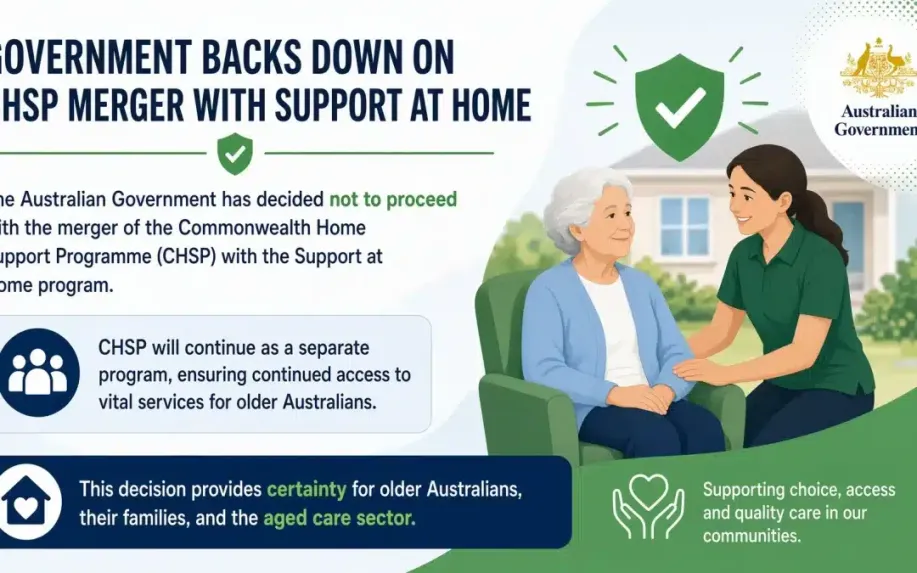
What if the biggest change to your home care was actually no change at all? The news that the Government backs down on CHSP merger with Support at Home has brought a much-needed sigh of relief to nearly 840,000 Australian seniors. Navigating the constant stream of policy updates and new terminology often feels like a full-time job, especially when you’re just trying to maintain your independence. It’s normal to feel anxious about whether your current entry-level services will suddenly vanish under the New Aged Care Act.
This article explains why the Australian Government delayed the merger and how it secures your access to care through to 30 June 2029. You’ll gain clarity on the dual-system roadmap for the next three years and understand exactly how CHSP differs from the Support at Home programme in 2026. We provide a steady guide through these changes so you can focus on living well at home.
Key Takeaways
- Learn why the Government backs down on CHSP merger with Support at Home and how this decision secures entry-level services until 30 June 2029.
- Understand how service continuity helps you keep your current providers while avoiding the stress of an immediate, mandatory funding reassessment.
- Identify the specific trigger points that indicate when you might need to transition from basic support to the more complex Support at Home programme.
- Gain a clear roadmap for 2026 to ensure your referral codes remain active and your care remains uninterrupted during this dual-system period.
Understanding the Government Backdown on the CHSP and Support at Home Merger
The Australian Government has confirmed a significant policy shift that provides immediate certainty for seniors. The decision that the Govt backs down on CHSP merger with Support at Home means the Commonwealth Home Support Programme (CHSP) will remain a standalone service until at least 30 June 2029. Originally, the New Aged Care Act aimed to consolidate all home care services into a single system starting in November 2025. This delay provides a vital buffer for the 838,694 people currently receiving entry-level support.
From the government’s viewpoint, this extension ensures continuity of care while the sector stabilises under the new legislative framework. However, industry perspectives reveal a more complex motivation. Many providers, particularly those delivering community-based services like meals and transport, argued that a rushed merger risked their financial viability. They successfully highlighted that the block-funding model used in CHSP is essential for maintaining these low-cost, preventative services within the broader landscape of aged care in Australia.
The New Timeline: CHSP vs Support at Home until 2029
Support at Home officially replaced Home Care Packages on 1 November 2025, focusing on those with complex clinical or personal care needs. Meanwhile, CHSP continues to act as the primary “entry-level” gatekeeper. For the next three years, seniors will navigate two distinct funding models depending on their care requirements. This means understanding the Commonwealth Home Support Programme (CHSP) remains essential for anyone seeking basic help with domestic chores or social support. It’s a dual system designed to prevent the rushed transition that many families feared.
What the CHSP Extension Means for Seniors and Their Families
The news that the Government backs down on CHSP merger with Support at Home provides immediate peace of mind for those worried about their daily help. For most seniors, this means you can keep your trusted providers without the anxiety of a sudden funding reassessment. You don’t have to worry about losing the specific person who comes to mow your lawn or help with the shopping. This stability is confirmed in the Official Government Announcement on CHSP.
However, there’s a trade-off. The system remains fragmented, meaning you might still face multiple assessments if your care needs increase. While the New Aged Care Act is now live, the CHSP operates under transitional arrangements. You might wonder, “why bother planning if things are staying the same?” It’s because the quality standards and consumer rights of the new Act still protect you, even within the CHSP. Staying organised ensures you aren’t caught off guard if the rules shift again.
Continuity of Service: Meals, Transport, and Social Support
If you currently have a referral code for meals support or other entry-level help, it remains active and valid. This extension prevents a “gap in care” for people who need a little help but aren’t ready for a full Support at Home package. Essential transport services also continue under their current block-funded model, ensuring you can still get to medical appointments or social groups. To stay informed about how these levels of care interact, you can browse our Aged Care Made Easy guides for clear, step-by-step advice.
Navigating the Dual System: Practical Steps for 2026
Now that the Government backs down on CHSP merger with Support at Home, your first task is to verify your current referral codes. Log into the My Aged Care portal to ensure your codes are active and correctly matched to a provider who still accepts CHSP subsidies. While the system is stable for now, you must identify ‘trigger points’ that might necessitate a move to the Support at Home programme. If your health needs shift from basic domestic help to complex clinical care or daily personal assistance, a new assessment for a higher funding level is required.
Comparison remains your best tool in this dual system. Use an independent aged care directory to find providers who have maintained their CHSP contracts. We recommend holding a family meeting to discuss long-term goals. While 2029 feels distant, it represents a hard deadline for the final merger. Planning early prevents a rushed decision when the transition eventually becomes mandatory.
Choosing the Right Provider in a Changing Landscape
The provider landscape is evolving quickly. Some organisations may choose to exit the CHSP early to focus exclusively on the Support at Home model. Look for Featured Directory Listings to identify proactive providers who are committed to the dual-system transition. When interviewing potential providers, ask directly about their 2029 transition plan. A prepared organisation will have a clear roadmap for how they intend to support you when the programmes finally merge.
Securing Your Care Through the Transition
The news that the Government backs down on CHSP merger with Support at Home provides a vital three year window of stability for your home care. You can now maintain your current entry level services until 30 June 2029 while the broader aged care landscape evolves. By verifying your referral codes and understanding the trigger points for higher care, you ensure that your support remains uninterrupted. It’s about staying proactive today so you aren’t overwhelmed by the final merger tomorrow.
We’re here to simplify this path for you. We invite you to find a home care provider who supports your needs during the transition. Trusted by Australian families since 2019, our national directory of vetted providers and free 2026 Aged Care Guides offer the practical help you need. You don’t have to navigate these changes alone; we are with you every step of the way.
Frequently Asked Questions
Is the CHSP being scrapped in 2026?
No, the Commonwealth Home Support Programme (CHSP) is not being scrapped in 2026. The Australian Government has officially extended the programme until 30 June 2029. This extension allows the 1,273 current providers to continue delivering basic support services under their existing block-funding arrangements. It provides a three year buffer for the sector to stabilise before any further changes to entry-level care are considered.
Can I stay on CHSP if I am already receiving services?
Yes, you can certainly stay on your current services. Since the Government backs down on CHSP merger with Support at Home, there is no requirement for existing clients to move to the new system immediately. You can maintain your relationship with your trusted providers for meals, transport, and domestic help. This decision ensures that nearly 840,000 seniors keep their essential support without the stress of a mandatory reassessment.
What is the difference between CHSP and the Support at Home program now?
The CHSP remains the primary gateway for entry-level, preventative support like social groups or minor home maintenance. It is funded through grants provided to organisations. Conversely, the Support at Home programme is designed for seniors with more complex clinical or personal care needs. It uses individualised annual budgets across eight classifications, with funding levels ranging from $10,732 for level one up to $78,106 for level eight.
Do I need a new ACAT assessment because of the merger delay?
You don’t need a new assessment just because the merger was delayed. Your current referral codes for CHSP services remain valid and active until 2029. You only need a new assessment if your care needs increase significantly, such as requiring help with showering, dressing, or continence care. In those cases, you would be assessed for the Support at Home programme, which provides higher levels of funded support.
Website Blog & Article Disclaimer
The information published on the Aged Care Made Easy Website is provided for general informational purposes only. All content, pricing, statistics, funding information, and service details were accurate to the best of our knowledge at the time of publication and may change without notice.
While we aim to keep information current and reliable, Aged Care Made Easy makes no guarantees regarding the accuracy, completeness, or suitability of any content. Readers should independently verify information with service providers, government departments, or qualified professionals before making decisions relating to aged care, health, financial, or legal matters.
Aged Care Made Easy is not responsible for any loss, damage, or decisions made based on the information contained within this website or linked third-party websites.
